
This post may contain affiliate links. By clicking and making a purchase through the links, I earn a small commission at no extra cost to you. See my disclaimer for more information. This and display ads allow me to keep the site up to date and give back.
If you’re wondering what the cost of traveling with a dog is, you’ve come to the right place! I’ve been traveling with my rescue dog, Puglo, across 22 countries over the last 3 years, and it’s added quite a bit of expenses to my life. Of course, it’s worth it to have my best friend by my side.
If you’re thinking about traveling the world with your dog, here’s a breakdown of some costs you might incur.
What traveling with a dog really costs
In my experience, traveling with Puglo adds roughly 150 to 400 US dollars to a typical trip. The airline fee is the predictable part. The paperwork is the wild card, and it swings from a couple of dollars to well over five hundred depending entirely on which country you’re leaving.
Traveling with a dog makes life more expensive, but most of the costs are manageable once you know they’re coming, and a few of them you can avoid completely.

Costs of traveling with a dog
Vaccines and treatments
Before traveling internationally with a dog, you need to ensure they meet the health requirements of the destination country. Fortunately for many countries, this can be as easy as having your rabies vaccine up-to-date. Other countries may require core vaccines such as Distemper, but it’s likely your dog will already be vaccinated for those.
It’s important to pay attention to timing, as some countries require vaccines to be given within the last year, and in the U.S. and Europe, a 3 year rabies vaccine is usually given, so you may need a booster.
Similarly, there is a waiting period of 21 days after the rabies vaccine is given for the EU, if it’s the first one.
As you would at home, it’s also important to ensure your dog is up-to-date on flea and tick and tapeworm treatments. Some countries, like the UK, require this to be given within 5 days of travel.
The cost of vaccines depends on the country you are getting them, but if your dog is not fully vaccinated yet, budget accordingly.
Additional Tests
Some countries, especially low or rabies-free destinations like Japan and Hawaii, require an additional test called the rabies titer test to prove your dog has rabies antibodies. I walk through it in my guide to the dog rabies titer test.
I submitted mine directly to Kansas state university for less than $100 but it was a huge hassle shipping the sample from Mexico. If you’re submitting it through a vet in the U.S. (which is much easier), they charge a few hundred for this.
Some countries, like South Africa, also require additional tests that can be quite costly, however this is not the norm.
Health certificates
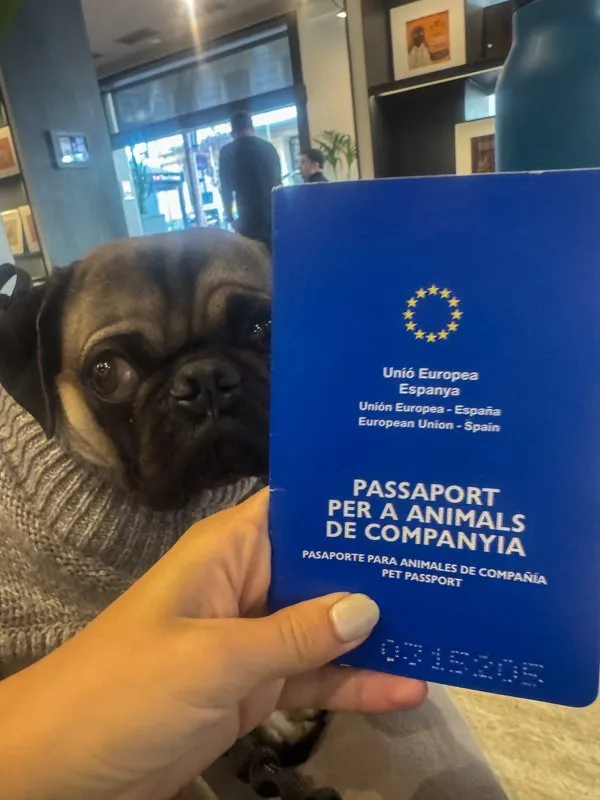
When you’re traveling internationally with a dog, you’ll need to get an export health certificate, and the first step of that is to get a health certificate from your vet, which varies in cost depending on the country. In Mexico, this only costs me 500 pesos ($30), whereas in the U.S. it’s the cost of a check-up, which is about $100.
If you’re bringing a dog from Mexico to the U.S., you’ll also need to factor in the cost of a certificate stating your dog is free of screwworm going both ways, which is a new requirement that started in 2026. In Mexico, it costs me about 1500 MXN ($80). I haven’t had to get one from the U.S., but it will be at least the cost of a vet visit.
Export certificates
This is the paperwork you need before the flight, and again, the price varies enormously by country.
Leaving Mexico, where we’re based, the government endorsement itself is free, you just pay in time, because it’s a bit of a headache to get.
Leaving the United States is a different world. You need a USDA-accredited veterinarian to complete the certificate, and then USDA APHIS has to endorse it. As of 2026 the APHIS endorsement fee alone starts at 101 dollars, and that is before your vet’s exam, or any vaccines and tests.
Travelers in my Facebook group routinely report 500 to 800 dollars all in. I haven’t personally paid this much, but we typically aren’t going from the U.S. You can check the current fee schedule on the USDA APHIS pet travel site.
Everywhere else has been far gentler. Germany cost me about 62 euros and Kazakhstan cost roughly 2 dollars. Export paperwork is usually affordable, and the U.S. is the outlier.
Vet visits on the road

Routine vet care abroad has been one of the nicest surprises. In Thailand, where I’m based part of the year, a standard visit runs about 6 US dollars. Compared to North American prices that’s close to free, and it means I’m far more relaxed about getting Puglo checked out when something seems slightly off.
If your pet needed treatment and it was safe to travel with them, it may actually be cheaper to go abroad to do it.
Airline pet fees

This is the cost most people do budget for, and it’s reasonably predictable. In my experience for traveling in cabin with a dog: around 50 dollars on a Canadian domestic flight, about 150 dollars in the United States, 150 euros in Europe domestic, and a couple of hundred on international routes. Cargo fees can be significantly more expensive if you’re traveling with a larger dog.
The fee is charged per direction, and often per segment. A one-stop itinerary can cost twice what you planned for. I always price the direct flight against the connection with the pet fee included before booking.
If you’re traveling on a pet-friendly airline where your dog can be out of the carrier, this is significantly more expensive. I cover this in detail in my guide to airlines that allow large dogs in cabin.
A note on service dogs and emotional support animals
Service dogs, and emotional support animals on the airlines that still accept them, are not charged pet fees the way regular pets are. Service dogs always travel for free, and emotional support animals often do, unless you need to buy additional space for them.
If you are traveling with a genuine ESA, my post on what airlines allow emotional support animals covers which carriers still accept them and what documentation they want.
Pet shippers
If you hire a pet shipping company to handle the move for you, expect to pay thousands, and often many thousands. It’s by far the most expensive way to get a dog from one country to another.
I’d avoid going this route unless you absolutely have to. Most of what a shipper does is paperwork, booking and ground transport, and you can usually work all of that out yourself with some patience and a bit of lead time. I walk through the whole process in my guide to traveling with a dog internationally.
Accommodation costs

I’ve paid between 10 and 20 US dollars a night for Puglo at hotels. That adds up fast on a two week trip, so I’m careful about how I book.
Look for apartments with no pet fee at all, or hotels with a flat fee per stay rather than per night. A 50 dollar flat fee on a ten night stay is a bargain, whereas a 20 dollar nightly fee on the same stay is 200 dollars. It’s the same hotel either way, at four times the cost.
Pet deposits are rarely a thing, which surprises people. And if a host quotes a per-night pet fee on a longer booking, it’s very often negotiable.
Food
Food adds up, but it’s something you’d be paying at home anyway, so I don’t count it as a travel cost. The downside of traveling is that you can’t buy in bulk, so you end up buying small bags more often, at whatever the local price happens to be.
Gear
You buy gear once and it lasts for years of trips. My core kit is a carrier that meets airline cabin dimensions, our travel backpack, a well-fitted harness, a GPS tracker, a life jacket, outfits for the climate, dog wipes, and a supply of poop bags.
Shop all of Puglo’s travel essentials here
Sitters and daycare
There are days when Puglo can’t come along, and that costs money too. Rover, TrustedHousesitters and local independent sitters and day cares help with this. Professional daycare is where it gets expensive, particularly in Europe and the United States.
What’s worked best for me is finding local sitters, or friends of friends, rather than booking a professional facility. It’s usually a fraction of the price and Puglo is far happier in someone’s home than in a kennel.
Ways to save money traveling with a dog
- Look for accommodation that doesn’t charge a pet fee, or a small pet fee per stay rather than per night
- Ask apartment hosts to waive or flatten a per-night pet fee on longer stays.
- Use house sitting and home exchanges, which cut accommodation and pet costs at the same time.
- Find local sitters or friends of friends instead of professional daycare.
- Price direct flights against connections with the pet fee included, since the fee is often charged per segment. Traveling direct is also less stressful for your pet.
- Traveling within areas that don’t require export paperwork between countries, like within the EU or between Canada and the US, can save you a significant amount of money and hassle. Export certificates and endorsements are often one of the more expensive and time consuming parts of international pet travel, so sticking to routes where that step doesn’t apply is one of the easiest ways to cut your costs without cutting your travel plans.
So is it worth it?
Yes, and I say that knowing exactly what it costs. The paperwork is tedious, the fees are real, and I’ve absolutely stood in a vet’s office in a foreign country wondering what I was doing. But the alternative is leaving him behind, and that was never going to be the answer for me.
How much does it cost to travel with a dog?
In my experience it adds roughly 150 to 400 US dollars to a typical trip. The airline fee is the predictable part, and the paperwork is the wild card, running from $100 leaving Mexico to well over $500 leaving the United States.
How much does it cost to travel with a dog?
In my experience it adds roughly 150 to 400 US dollars to a typical trip. The airline fee is the predictable part, and the paperwork is the wild card, running from $100 leaving Mexico to well over $500 leaving the United States.
How much do airlines charge for a dog in the cabin?
It depends on the route. I’ve paid around 50 dollars on Canadian domestic flights, roughly 150 dollars in the United States, and a couple of hundred on international routes.
Do hotels charge extra for dogs?
Some do. I’ve paid between 10 and 20 dollars a night for Puglo. A flat fee per stay is far better than a per-night fee on a long trip.
Can I buy a seat for my dog on an airplane?
On almost every airline, no. Your dog travels in a carrier under the seat in front of you, and buying an extra seat doesn’t change that rule, so the only way around it is flying with an operator built specifically for dogs.
What airline lets dogs sit in a seat?
Pet-first charter operators like BARK Air and K9 Jets let dogs travel out of a carrier in the cabin, with one ticket covering a human and their dog. ITA Airways also carries dogs up to 30 kg in the cabin through its Large Dog On Board service, on a selected list of domestic Italian routes.
Which airlines offer pet friendly flights?
Most major airlines take small dogs in the cabin, and the differences are in weight limits, carrier size and how many pets they allow per flight.
Is it hard to fly internationally with a dog?
The flight is the easy part. The paperwork is what makes it feel hard, because every country wants something slightly different and the timing windows are tight.

